
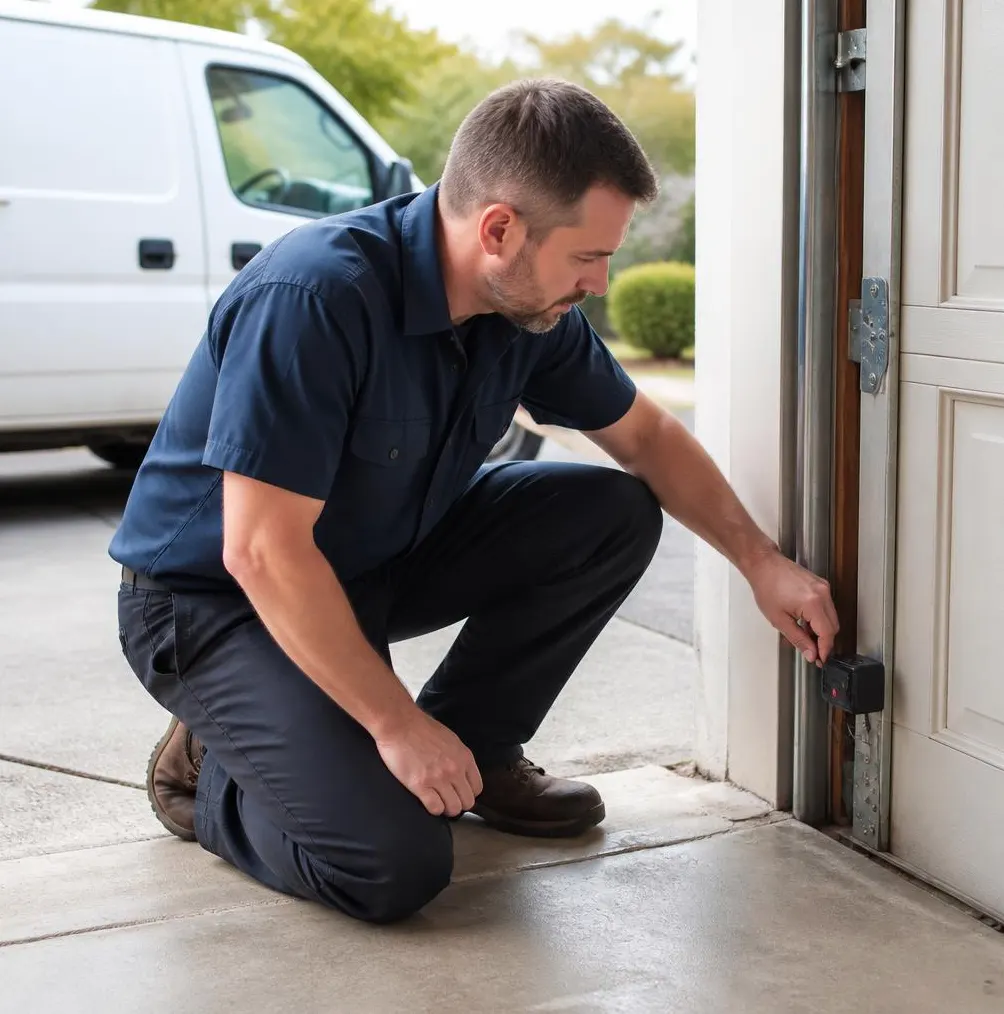
The first thing most homeowners do when the garage door won't budge on a freezing morning is hit the opener button again. Then again. When that fails, they try prying the door up by hand, or chipping at the bottom edge with a shovel. It's a tempting move — the door usually just opens, so the logic is that more force or more tries should fix it. But if the door is actually frozen to the slab, forcing it is exactly how you snap a cable, strip opener gears, bend a track, or tear a bottom panel. Before touching anything, it helps to know what's actually going on underneath.
Symptoms That Point to a Cold-Weather Problem
- Door won't move at all — the opener motor hums or clicks, but the door stays put
- A visible line of ice or frost right where the bottom edge meets the concrete
- Door opens a few inches, then stalls, reverses, or the opener trips its safety reversal
- Noticeably slower, jerkier movement than usual, sometimes with grinding or squealing
- Door feels unusually heavy if you try to lift it manually
- Everything works fine most days, but struggles specifically on cold mornings after snow or rain the night before
What a Technician Checks, in Order
1. The bottom seal frozen to the slab
This is the most common cause of a door that's truly stuck. Melting snow or slush drips under the door overnight, pools along the bottom edge, and refreezes into a thin ice weld between the rubber seal and the concrete floor. The fix is not opener power or elbow grease. Use a hair dryer, a heat gun on low, or warm — not boiling — water poured along the seal line to break the bond, then scrape gently with a plastic edge. A de-icer rated safe for rubber and concrete works too. Once the door moves freely, dry the seal before closing it again so it doesn't refreeze in the same spot.
2. Brittle or stuck weatherstripping
Cold makes rubber weatherstripping stiff and less forgiving, and on the older housing stock common around here, that seal may already be cracked or compressed from age, giving ice more surface to grip. A technician checks whether the weatherstripping is simply hardened from the cold or whether it's worn out and needs replacing with a cold-rated vinyl or rubber gasket. They'll also check the retainer track that holds the seal, since a bent one is common on original doors that have never been touched.
3. Thickened lubricant on rollers, hinges, and tracks
Standard grease — and even some lubricants marketed for garage doors — thickens in low temperatures, making rollers drag and hinges resist. This is usually what causes sluggish, jerky movement and a grinding or squealing sound even when nothing is actually frozen. The fix is to wipe off old, gummed-up lubricant and apply a lithium- or silicone-based lubricant rated for cold climates to the rollers, hinges, and track. Skip household sprays like WD-40 — they displace moisture short-term but don't hold up through a winter of freeze-thaw cycles.
4. Ice or debris packed into the tracks
Nor'easters and the freeze-thaw swings typical of a Litchfield County winter push slush into the track channels, where it refreezes solid and physically blocks the rollers. A technician clears the tracks with a plastic scraper and checks alignment at the same time, since cold contraction often exposes a track that was already slightly out of true but hadn't caused problems yet.
5. Spring tension affected by the cold
Steel torsion and extension springs contract slightly in extreme cold, which changes how balanced the door feels and adds strain to an opener that's already fighting stiff rollers and a frozen seal. Springs that are near the end of their service life are especially likely to fail during a cold snap, because the added resistance from everything upstream is often the final stress they can't absorb. This is checked by testing door balance and spring tension by hand, and if a spring is worn, cracked, or has already broken, it gets replaced. This is not a DIY repair — the stored tension in a torsion spring can cause serious injury.
6. Opener force settings and sensors
If the door is a little stiffer than normal from cold seals, thick grease, or tight springs, the opener may read that extra resistance as an obstruction and reverse the door automatically as a safety feature. Frost or condensation on the photo-eye sensors can trigger the same false reversal. A technician clears the sensors, rechecks the opener's force and limit settings, and tests the motor's actual performance — older opener motors can lose torque capacity in cold weather and may need repair or replacement if they're already on their way out.
When to Call Woodbury Garage Door
If your door has frozen to the ground more than once this season, feels slower than it used to, or stalls partway through its cycle, that's worth a service call rather than another round of hair dryers and hope. Woodbury Garage Door's maintenance service covers a full inspection — lubrication, track alignment, seal condition, and spring balance — tuned to what a Woodbury, CT winter actually does to a door. If a spring has already let go, or you hear a loud bang followed by a door that won't lift at all, that's spring replacement territory, and it should be handled by a trained technician given the force involved.
Don't wait for a frozen door to turn into a bigger repair bill. Call Woodbury Garage Door for maintenance or emergency service anywhere in Woodbury, CT and the surrounding towns.